Animal Models of Autistic-like Behavior in Rodents: A Scoping Review and Call for a Comprehensive Scoring System
(Full-text capture 2026-09-21; web artifacts lightly stripped; truncated.)
by
Asher Ornoy
Asher Ornoy
SciProfiles Scilit Preprints.org Google Scholar
Boniface Echefu
Boniface Echefu
SciProfiles Scilit Preprints.org Google Scholar
Maria Becker
Maria Becker
SciProfiles Scilit Preprints.org Google Scholar
1
Department of Morphological Sciences and Teratology, Adelson School of Medicine, Ariel University, Ariel 40700, Israel
2
Hadassah Academic College, Jerusalem 9101001, Israel
3
Hadassah Medical School, Hebrew University, Jerusalem 9112102, Israel
*
Author to whom correspondence should be addressed.
Int. J. Mol. Sci. 2024, 25(19), 10469; https://doi.org/10.3390/ijms251910469
Submission received: 28 August 2024 / Revised: 24 September 2024 / Accepted: 25 September 2024 / Published: 28 September 2024
(This article belongs to the Special Issue Animal Research Model for Neurological Diseases)
Download keyboard_arrow_down
Abstract
Appropriate animal models of human diseases are a cornerstone in the advancement of science and medicine. To create animal models of neuropsychiatric and neurobehavioral diseases such as autism spectrum disorder (ASD) necessitates the development of sufficient neurobehavioral measuring tools to translate human behavior to expected measurable behavioral features in animals. If possible, the severity of the symptoms should also be assessed. Indeed, at least in rodents, adequate neurobehavioral and neurological tests have been developed. Since ASD is characterized by a number of specific behavioral trends with significant severity, animal models of autistic-like behavior have to demonstrate the specific characteristic features, namely impaired social interactions, communication deficits, and restricted, repetitive behavioral patterns, with association to several additional impairments such as somatosensory, motor, and memory impairments. Thus, an appropriate model must show behavioral impairment of a minimal number of neurobehavioral characteristics using an adequate number of behavioral tests. The proper animal models enable the study of ASD-like-behavior from the etiologic, pathogenetic, and therapeutic aspects. From the etiologic aspects, models have been developed by the use of immunogenic substances like polyinosinic-polycytidylic acid (PolyIC), lipopolysaccharide (LPS), and propionic acid, or other well-documented immunogens or pathogens, like Mycobacterium tuberculosis. Another approach is the use of chemicals like valproic acid, polychlorinated biphenyls (PCBs), organophosphate pesticides like chlorpyrifos (CPF), and others. These substances were administered either prenatally, generally after the period of major organogenesis, or, especially in rodents, during early postnatal life. In addition, using modern genetic manipulation methods, genetic models have been created of almost all human genetic diseases that are manifested by autistic-like behavior (i.e., fragile X, Rett syndrome, SHANK gene mutation, neuroligin genes, and others). Ideally, we should not only evaluate the different behavioral modes affected by the ASD-like behavior, but also assess the severity of the behavioral deviations by an appropriate scoring system, as applied to humans. We therefore propose a scoring system for improved assessment of ASD-like behavior in animal models.
Keywords:
ASD-like behavior; animal models; neurodevelopmental disorders; scoring system
1. Introduction
Animal modeling of human diseases significantly contributes to the enhancement of our comprehension of disease etiology, pathogenesis, and potential treatments [ 1, 2, 3]. Various mammalian models, including mice, rats, rabbits, pigs, and non-human primates, have been developed due to genetic proximity to humans, easy handling, and relevance to specific disease aspects [ 3]. In the last several decades, non-mammalian animals have also been used, including amphibians, avian models, and, lately, zebrafish [ 3, 4, 5, 6, 7]. Generally, animal models for human diseases are required to meet three basic values: face validity, when animals recapitulate disease phenotype in similarity to humans; etiologic (construct) validity (relevance), when pathophysiological processes in animals are similar to those that cause disease in humans; and predictive validity (pharmacologic sensitivity), when animals respond to medications that are effective to treat the human disease [ 8]. Often the causation of the human diseases and of the disease in animal models are similar, as are the symptoms, complications, and treatment. Hence, there are genetic and non-genetic animal models used for the study of almost all human diseases.
The American Psychiatric Association’s Diagnostic and Statistical Manual, Fifth Edition, 2013 (DSM-5) provides standardized criteria to diagnose ASD [ 9]. The diagnostic features associated with ASD are a triad of impaired social interactions, verbal and nonverbal communication deficits, and restricted, repetitive behavioral patterns that may also be associated with somatosensory and special senses impairments.
Careful phenotypic characterization of ASD animal models is essential to ensure that they accurately recapitulate key features of the human disorder. This includes assessing behavioral, cognitive, social, and communication deficits that are relevant to human symptoms. If there are only a few behavioral changes, or behavioral tests have not been sufficiently applied to assess most of the typical ASD-like behaviors, the resemblance to human ASD is incomplete.
Modeling in animals of neurodevelopmental disorders such as ASD is challenging and complex because the etiology and pathogenesis of ASD are multifactorial and still unclear [ 10]. One significant difficulty is that ASD is presently diagnosed based on a set of core behavioral abnormalities rather than objective biomarkers [ 11]. The diagnostic criteria for ASD rely on observable behaviors such as impaired social interaction, communication deficits, and repetitive or restricted interests and behaviors. Unlike disorders with clear physiological markers, such as certain genetic conditions or infectious diseases, ASD lacks physiological biomarkers that can be easily measured or quantified. Furthermore, the heterogeneity of ASD etiology encloses a wide range of symptoms and a wide range of severity levels [ 10]. Therefore, the development of animal models that may reflect this variability of ASD is difficult, and requires accounting for genetic diversity and environmental and developmental factors that contribute to the disorder. Many currently established ASD-like animal models, either induced or genetic, exhibit behavioral traits associated with ASD. However, many models still fail to fully reflect the complexity of human ASD.
While there are no established biological markers for ASD, identifying translational biomarkers in animal models can facilitate the translation of preclinical findings to clinical settings. This may include molecular, neuroimaging, or electrophysiological biomarkers that reflect underlying neural circuitry abnormalities or treatment responses.
Several strategies are utilized for designing mouse models of ASD [ 12, 13]. Genetic models using knockout techniques, Transcription Activator-Like Effector Nucleases (TALENs) and CRISPR/Cas9, and gene editing technologies introducing mutations or deletions in genes associated with ASD in mice can mimic genetic factors contributing to the disorder in humans. This includes manipulating genes such as Methyl-CpG Binding Protein 2 (MeCP2), fragile X messenger ribonucleoprotein 1 (FMR1), SH3 and Multiple Ankyrin Repeat Domains 3 (SHANK3), and neuroligin (NLGN), which have been implicated in ASD, often with clinical differences between genders [ 14].
Many tests are employed in animals to assess various behavioral deviations. The utilization of appropriate behavioral tests for each core behavior is crucial for establishing conviction for the validity of the core domain of the autism symptoms being assessed. The domains, based on the criteria that define autistic subjects in DSM-5, are social interaction, communication and motivation, and restrictive-repetitive behaviors, as well as tests for the assessment of various behavioral changes often observed in autism like anxiety, learning and memory difficulties, and sensory and motor difficulties.
We will present various studies describing different animal models of ASD-like behavior that used different behavioral tests diagnostic for specific neurobehavioral features found in ASD. Generally, investigators did not define the severity of these behavioral deviations and sometimes assessed only a few of the typical autistic-like behaviors. This raises the question in which conditions are the models only demonstrating features of autistic-like behavior that may sometimes be found in various neuropsychiatric disorders or demonstrating the full spectrum of autistic-like behavior. An additional question is whether a scoring system, similar to that used in human, will improve the face and construct validity of these models.
Behavioral categorization may guide researchers to the development and implementation of comprehensive and acceptable scoring methods for validating animal models of ASD-like phenotypes. It is noteworthy that ASD is diagnosed only if there is a set of well-defined clinical presentations. Hence, to prove that the animal exhibits ASD-like behaviors, studies must demonstrate characteristic behavioral features that can be delineated only when using a variety of behavioral tests. Generally, relying on too few behavioral tests demonstrates only specific behavioral deviations that may be representative of ASD but also of other neuropsychiatric disorders as they demonstrate only some of the characteristic features of ASD. We are not suggesting, however, that a single model must show all features of ASD, but rather advocate for a reproducible behavioral phenotyping that is robust enough for predictive validity.
In this review we will discuss genetic and non-genetic models of ASD, the way they are produced and the methods for verification that the clinical behavioral symptoms are like those observed in human ASD. We will also discuss briefly various tests for the assessment of behavioral deviations associated with ASD and propose a scoring system to assess the severity of the ASD-like behavioral symptoms.
2. Brief Description of Behavioral Assays That Define ASD-like Behaviors in Rodents
There are many tests for the evaluation of the different behaviors in animals, especially in rodents. Moreover, several specific tests often measure the same behaviors. We will not discuss these different behaviors at length, but describe them only briefly according to the behavioral features they are meant to measure.
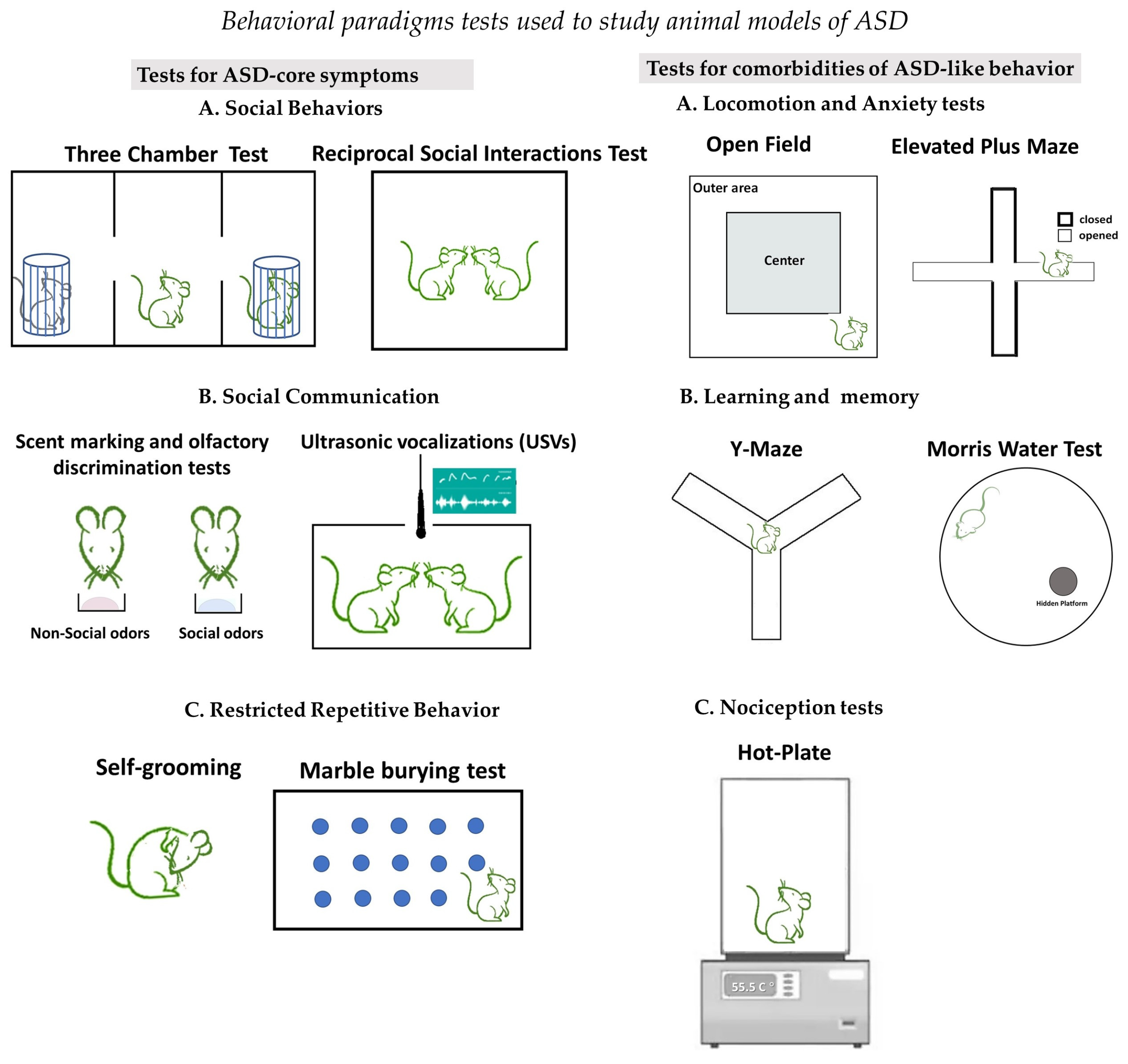
These behavioral tests are grouped into batteries and described briefly with reference to studies describing them in detail. These test batteries are namely for social interaction, communication, restrictive-repetitive behaviors, and comorbidities ( Figure 1 ).
2.1. Tests to Investigate Social Behaviors
The three-chamber test for sociability and novel social preference, originally developed by Crawley and colleagues, is the most widely used measure for sociability and social recognition assays in rodents [ 13, 15]. The objective of test initially to test for social interaction between a subject and conspecific can now be expanded to concomitantly test also for social preference [ 16, 17, 18, 19, 20, 21]. The social partition test is similarly employed to assess abnormality in social behavior of ASD-like rodent models [ 22]. The reciprocal social interactions assay is used to observe how animal reciprocates social advances (consisting of sniffing, following, chasing, pushing past, crawling over, pushing under, grooming, fast-paced wrestling, pouncing, pinning, chasing, and boxing) made towards it by a conspecific [ 13, 23]. The test for social motivation is primarily used to evaluate how rewarding a test animal finds a socially conditioned environment [ 13]. With proper application of these standardized tests in various contexts and results comparison, researchers can gain a more comprehensive understanding of the subject’s social behavior that may be cryptic in one test only. Corroboratory assays may show social behavior that can differ across different settings, helping to interpret the findings in the presence of potential physical or cognitive deficit. The overall goal of these tests is to provide a reliable and systematic way to characterize social behaviors in animal models, which can contribute to the understanding of the underlying mechanisms and development of potential interventions for social impairments observed in ASD.
2.2. Tests to Investigate Social Communication
The scent marking test aims to investigate non-verbal communication in rodents. Naturally, rodents communicate via olfactory signals such as scent markings and pheromones [ 24]. The paradigm can be modified for habituation and dishabituation (OHDH) test [ 25, 26]. The latter paradigm serves the same purpose as the olfactory discrimination index test [ 27]. Ultrasonic vocalizations (USVs) are the major communication sounds used by rodents at reported frequencies ranging between 30 to 110 kHz [ 28, 29, 30]. USV emissions can provide evidence of an early-life social communication abnormality [ 29, 31, 32, 33] and can be a tool for early behavioral ASD phenotyping [ 33]
Olfactory signals and ultrasonic vocalizations provide complementary approaches to study communication in rodent models of ASD. Test results provide valuable insights into the social communication deficits present in ASD-like phenotypes for a better understanding of the underlying mechanisms, and the development of early detection and intervention strategies.
2.3. Tests to Investigate Restricted Repetitive Behaviors
Restricted, repetitive patterns of behavior and interests in ASD can include any stereotyped or repetitive motor movements, insistence on sameness and inflexible routines, highly restricted and fixated interests, hyper/hypo-reactivity to sensory input, and unusual fascinations and fixation on objects [ 9, 34]. It is therefore practically impossible to have one paradigm assay that can sufficiently test these behavioral patterns. This highlights again the need to evaluate more than a single task for several domains of ASD when designing animal models.
Below are some of the most widely employed techniques that can be used to observe some repetitive patterns in rodent models of autistic-like behavior.
The marble burying test examines in rodents the presence of obsessive/compulsive repetitive digging behavior, a typical autistic-like model [ 35]. Repetitive behaviors in rodents can also be observed in normal home cage activities like self-grooming, bedding, backflipping, circling, and jumping [ 36, 37]. Other tests, for restricted repetitive interest include novel object/hole, the Y-Maze [ 13], the water T-maze (WTM), and the Barnes maze [ 38, 39].
2.4. Tests to Investigate for Comorbidities of ASD-like Behaviors
Below are snippets of few corroboratory tests that can be employed for comprehensive assessment across cognitive, motor, and sensory domains to fully characterize the ASD phenotype and avoid potential confounds.
The Y-Maze Spontaneous Alternation test measures hippocampal function and short-term memory [ 20, 40]. The novel object recognition (NOR) test assesses intellectual difficulties, which affect around 70% of ASD cases [ 13]. The Morris water maze (MWM) tests spatial learning, memory, and reversal learning [ 41]. The fear conditioning test measures fear memory by associating a foot shock with contextual or auditory cues [ 42] Motor coordination and balance paradigms, e.g., the rotarod and beam walking, assess motor coordination, balance, and motor skill learning [ 43]. Anxiety-like behavior is assayed using an elevated plus maze and light–dark box tests [ 39, 44]. The open field locomotory test assesses general locomotion and exploratory behavior [ 16, 36]. Nociception tests are performed using hot-plate and tail-flick tests measure sensory processing [ 45, 46], with ASD models sometimes showing enhanced nociception or hyperalgesia [ 47, 48].
3. Non-Genetic Models of ASD-like Behaviors
Non-genetic rodent models are widely used models of ASD-like behavior because of their preclinical and clinical relevance, validity in disease etiology, and resemblance to human symptoms [ 5, 49]. They are manipulated to mimic environmentally induced autistic-like behavior in humans. Rodents are prenatally or early postnatally exposed to a variety of chemical substances or biological maneuver to demonstrate the validity of the use of animal models to recapitulate ASD-like phenomena and symptoms [ 39, 40]. These models have continued to advance the understanding of the different key behavioral and neurobiological features observed in human ASD, namely asocial and repetitive behaviors, communication deficits, and cognitive impairment. These studies collectively validate important mechanisms involving genetic and epigenetic factors, immune dysregulation, oxidative stress, and environmental constraints in the development and progression of ASD. These models have revealed vital information on potential targets for further research and therapeutic interventions. The more recent ones will be discussed briefly.
3.1. Biological Models of ASD-like Behaviors
Maternal immune activation (MIA), or activation of the maternal immune system by inflammation processes, is thought to play a significant role in the development of autism [ 39, 50, 51, 52]. Several rodent models of ASD-like behavior have been developed to recapitulate human disease phenotype by eliciting infectious processes prenatally or early postnatally using varieties of biological maneuvers [ 53, 54]. A nonhuman primate model (rhesus monkey) administered maternal immunoglobulin G (IgG) class antibodies that were purified from mothers of ASD children produced offspring with ASD-like behavior [ 55]. Using a three-chamber approach, the IgG-ASD-like offspring was asocial to conspecific and showed impaired reciprocal social interaction. Magnetic resonance imaging of the brain revealed that male IgG-ASD offspring had enlarged frontal lobes white matter volume compared with controls [ 55]. Jones et al. and Bruce et al. generated mouse and rat models of maternal immune activation (MIA) [ 44, 53] by injecting females with multiple antigenic epitopes two weeks before pregnancy to activate specific autoantibody production. Following pregnancy and parturition, pups were tested for neurodevelopmental milestones from PND 4-14. The adults were assessed for behavioral deficits using the battery of behavioral assays: reciprocal social interaction, three-chamber approach, repetitive grooming, marble burying, USVs, Morris water maze, open field, light and dark exploration, and elevated plus maze. Results in mice showed no difference between the offspring of MIA and control in the three-chamber social approach, although there was significant repetitive self-grooming, reduced vocalization to social cues, and altered neurodevelopmental trajectory in pups. In rats, the pups showed lower body temperature, reduced pup calls, and increased performance in negative geotaxis. Exposed adults showed significantly less interest in social interaction [ 44, 53]. Most frequently, polyinosinic-polycytidylic acid (PolyIC), a double-stranded RNA molecule that stimulates an immune response through the activation of toll-like receptor 3, has been widely employed to model autistic-like behavior in rodents [ 56, 57, 58] ( Table 1).
Lipopolysaccharide (LPS) and propionic acid are also well-documented immunogens used pre- and postnatally to produce rodent models of ASD-like behavior [ 59, 60, 61, 62]. Wu et al. induced MIA in zebrafish 24 h before mating by treating females with Poly(I:C) intraperitoneally [ 61]. Their findings from behavioral assays—three-chamber, shoaling, open field, and social preference test—suggest that offspring of MIA induced mothers exhibited impaired social approach and social cohesion, similar to human ASD phenotypes. These findings were attributed to mediation by toll-like receptors 3 and 4, and the role of villin-1 (vil1) pathway. In recent past, pathogens like Mycobacterium tuberculosis, have also been reported as inducing factors for ASD [ 63]. These modeling methods are achieved by the maternal response to induced infection resulting in immunological dysregulation, or by activation of the immune system in the absence of infection that could cross the placenta [ 65].
These models of autistic-like behavior produced by maternal immune activation provide important insights on significant risk factor for ASD. They enable investigation of the underlying biological mechanisms and translational research to advance human autism diagnostics and management. The models hold potential that may aid biomarkers identification for early detection of autism risk in children. This study continues to shed light on the complex etiology of autism and encourages rigor in future research strategies.
3.2. Chemical Models of ASD-like Behaviors
Several chemical compounds have been used to demonstrate environmental components in the etiology of ASD-like phenotype in humans and animals. Epidemiologic studies have shown that there is 3–5% increase rate of ASD among offspring of epileptic mothers, who at the time of pregnancy undertake valproic acid (VPA) treatment, compared to the general population [ 66]. Exposing pregnant rodents to VPA has been established as a modeling tool for studying ASD-like behavior [ 49, 66, 67]. VPA models have demonstrated both construct and face validity in similarity to human ASD symptoms [ 14, 49]. During pregnancy and early post-natal life, exposure to VPA is associated with impaired behaviors as manifested by different behavioral tests [ 39]. Interestingly, some VPA rodent models show a sex-dependent variation in behavioral outcome as commonly seen in humans with autism [ 68]. In addition to behavioral deficits, a reduced number of neurons in motor cranial nerves nuclei, reduced Purkinje cells, and size of the cerebellar hemispheres, as well as changes in the expression of many genes, some of them found to be associated with human ASD, have been reported in VPA-induced ASD-like behavioral models [ 49] ( Table 2).
We produced an ASD-like phenotype in ICR outbred mice with 300 mg of VPA on PND 4. ICR mice are widely used outbred strains, known for their more genetic variation background as compared to inbred strains, mimicking genetic diversity in the human population [ 74, 75]. Starting from PND 50, mice were assessed on three-chamber, elevated plus, water T-maze, and open field test. VPA models exhibited neurobehavioral deficits typical of ASD that were more prominent in males. Altered expression of antioxidant genes in the prefrontal cortex and enhanced oxidative stress were observed [ 40]. The observed ASD-like behavior must have resulted from epigenetic changes. Further studies revealed changes in the expression of 146 neuropathology and neurophysiology genes, some of them known to be involved in the neuropathology of ASD [ 76].
To study the involvement of purinergic signaling system on the development of ASD, a VPA rat model of ASD was generated by treating pregnant Wistar rats with 600 mg/kg of VPA on GD 12.5 [ 37]. Behavioral studies using three-chamber, reciprocal social interaction, open field/self-grooming and elevated plus maze paradigm showed that VPA induced in the offspring decreased reciprocal social interactions, impaired sociability index, and increased anxiety and nociceptive threshold. They also showed that VPA induced upregulation of interleukin 6 (IL-6), P2X4, and P2Y2 receptor expression in the hippocampus and medial prefrontal cortex [ 64].
Chen et al. performed ASD-related assays on VPA-treated zebrafish at different developmental time points [ 69]. They revealed that VPA induced a hyperactive movement disorder and increased time spent in the light area with less crossing in zebrafish. There was significantly less attack in the mirror test and time spent in the mirror zone. They found increased distance between VPA offspring in the shoaling test, and less contact duration and frequency when compared to the controls. There was an increase in cell and neural stem cell proliferation in the brain region, which might have contributed to the brain overgrowth macrocephaly observed [ 69].
To investigate brain lateralization in ASD, Messina et al. [ 73] treated zebrafish embryos for 48 h with 1 µM of VPA starting 8 h post fertilization. VPA-treated zebrafish exhibited impaired social behavior and defects in social visual laterality to the image in the mirror [ 73]. These behaviors corresponded with altered brain asymmetric gene expression and morphology in the thalamus and the telencephalon. Changes in cortical synaptogenesis, synaptic function, behavior, and gene expression in the marmoset (a new world monkey) model of VPA-induced ASD-like phenotypes were studied by Watanabe et al. [ 71]. In the study, 200 mg VPA was orally administered to pregnant marmosets from GD 60 to GD 66. Whole cell electrophysiological recordings showed altered synaptic plasticity, and microarray brain gene expression studies revealed 1037 differentially expressed genes that are positively correlated to brain gene expression in ASD in humans [ 71]. These alterations were accompanied by altered infant and juvenile vocalizations as tested by a pulse code modulation (PCM) audio recorder [ 71].
Polychlorinated biphenyls (PCB), an endocrine disrupting chemical (EDCs), is an environmental contaminant that may affect many neuroendocrine functions [ 13]. Human epidemiological studies have associated prenatal and early postnatal exposure to high levels of PCBs with an increased risk of ASD [ 77]. Bisphenol A exposure to Sprague Dawley rats in utero or early postnatal life is associated with an increased risk of ASD-like behavior, manifested as altered social behavior in the partition test and three-chamber test, increased anxiety exhibited on elevated plus maze test, sociosexual preferences recorded from the ultrasonic vocalizations (USVs) during social contact with the opposite sex [ 78], and social-context deficits when tested in a two-chamber partition paradigm [ 70]. Rats administered 25 mg/kg of PCB from GD 3 to parturition exhibited significant impairment of social recognition in a two-chamber social recognition paradigm [ 70]. Isolation-induced social investigation in the adult offspring was reduced. These asocial phenotypes, typical of ASD, were linked to the observed significant reduction in the periventricular nucleus, part of the hypothalamus that mediates social behavior and stress [ 70].
Prenatal exposure to the organophosphate pesticide chlorpyrifos (CPF) in humans is also associated with impaired social preference, restricted or repetitive behavior, and alteration in social communication [ 33, 72]. Young people are known to be more susceptible to the toxicity of CPF in communities where it is employed for agricultural purposes. Depending on the dose, CPF alters expression levels of genes involved in the development of neuronal communication, motor coordination, and learning (Lan et al., 2017). Several studies used CPF-induced mice model to mimic human ASD symptoms to advance understanding of the condition [ 79, 80, 81]. Treatment of pregnant Wistar rats on GD 12.5 with CPF induced in the offspring a significantly decreased number of calls and high latency to start calling in USVs recordings [ 82]. The type of calls and peak frequencies were not changed in comparison to the control.
To test for ASD-like social and repetitive behavior in mouse model, Lan et al. [ 72] administered 5 mg of CPF orally to pregnant mice from GDs 12–15. Social preference and social conditioned place preference, social novelty, object recognition, and restricted interest tests were assayed on the offspring at postnatal day 90. CPF-exposed mice showed dampened preference for unfamiliar conspecific and reduced social conditioned place preference with enhanced restricted interest [ 72].
4. Genetic Models in Rodents for ASD-like Behaviors
The heritability of ASD has been calculated as very high, based on twin studies [ 83, 84]. It seems to involve the influence of multiple genes, making it unlikely that a single gene will elucidate the genetics behind the majority of ASD cases. About 15–25% of ASD cases are syndromic, wherein the autistic presentation is just one part of a broader neurological syndrome. The rest of the cases represent non-syndromic ASD, where the main symptoms are communication and social impairment accompanied by stereotyped behaviors [ 85]. It is accepted that about 10–20% of ASD cases are related to defined rare mutations, genetic syndromes with highly penetrant chromosomal abnormalities, and de novo copy number [ 86, 87] ( Table 3).
De novo mutations (DNMs) and risk genes of ASD have been identified among ASD cases and are considered important factors that contribute to the diversity of symptoms, disease severity, and sex-related differences in higher male vs. female genetic liability, susceptibility, and development of ASD in either sporadic or familial pattern [ 88, 89]. These DNMs corresponded with the genes that are mostly associated with biological pathways related to chromatin remodeling, transcriptional regulation, and synaptic functions [ 90].
Using the homologous recombination and CRISPR/Cas9 technique, numerous models of knock-out/knock-in mice were generated based on the various defined DNMs and potential risk genes of ASD in human patients [ 91, 92, 93, 94].
The Simons Foundation Autism Research Initiative (SFARI) gene database Mouse Models module provides an integrated envelopment of the current findings at the molecular, cellular, and behavioral levels in ASD ( https://gene.sfari.org/database/animal-models/genetic-animal-models/, access online: 27 September 24), extracted from peer-reviewed scientific literature and annotated by expert biologists [ 95]. The animal models presented in SFAR
(Truncated: full text at source URL.)