Parametric Stimulus Design for IED Tasks
Designing stimulus spaces for the intradimensional-extradimensional-shift (ID/ED) task requires objects with at least two independently variable perceptual dimensions, the ability to generate many novel exemplars within each dimension, and careful control of confounds (area, luminance, edge density) to ensure subjects attend to the intended features rather than correlated low-level cues.
The core challenge: the generator must produce many novel exemplars within each dimension (not just many combinations of a few objects), and the dimensions must be sufficiently separable that an extradimensional shift measures attentional flexibility rather than feature-salience differences.
Recommended Architecture
A four-dimensional microorganism library, using only two dimensions within any one CANTAB-style IED sequence:
| Library dimension | Parameterisation |
|---|---|
| Shape | contour frequency, phase and curvature |
| Surface | spots, stripes, cellular, smooth |
| Appendages | straight, curved, forked, club-ended |
| Colour | calibrated hue at matched luminance |
Different task versions test whether ED costs generalise across dimension pairs:
- Shape vs texture
- Shape vs appendage type
- Colour vs texture
- Colour vs appendage type
- Shape vs motion
- Texture vs motion
CANTAB-Faithful Nine-Stage Implementation
A microorganism version preserving the original task logic:
| Stage | Stimulus construction |
|---|---|
| 1. SD | Two body shapes, no surface feature |
| 2. SDR | Reward contingencies reversed |
| 3. CD1 | Surface patterns introduced adjacent to the bodies |
| 4. CD2 | Surface patterns moved inside the bodies |
| 5. CDR | Reward contingencies reversed |
| 6. IDS | New body shapes and new patterns; shape remains relevant |
| 7. IDR | Reward contingencies reversed |
| 8. EDS | New shapes and patterns; pattern becomes relevant |
| 9. EDR | Reward contingencies reversed |
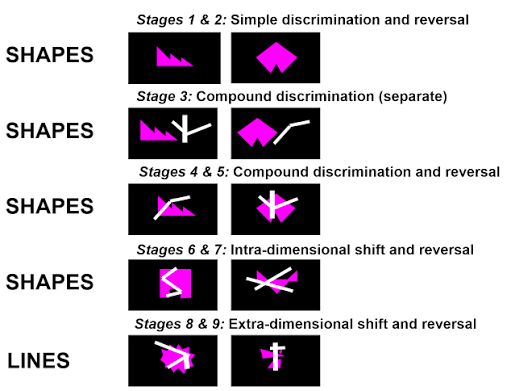
Schematic of the nine-stage CANTAB IED task progression. Shapes (purple) are the relevant dimension through Stages 1–7 (simple → compound → intra-dimensional shift). At Stage 8 (extra-dimensional shift), lines become the relevant dimension. See the intradimensional-extradimensional-shift page for full details.
The gradual progression from separate to compound dimensions mirrors the standard CANTAB arrangement [9]. 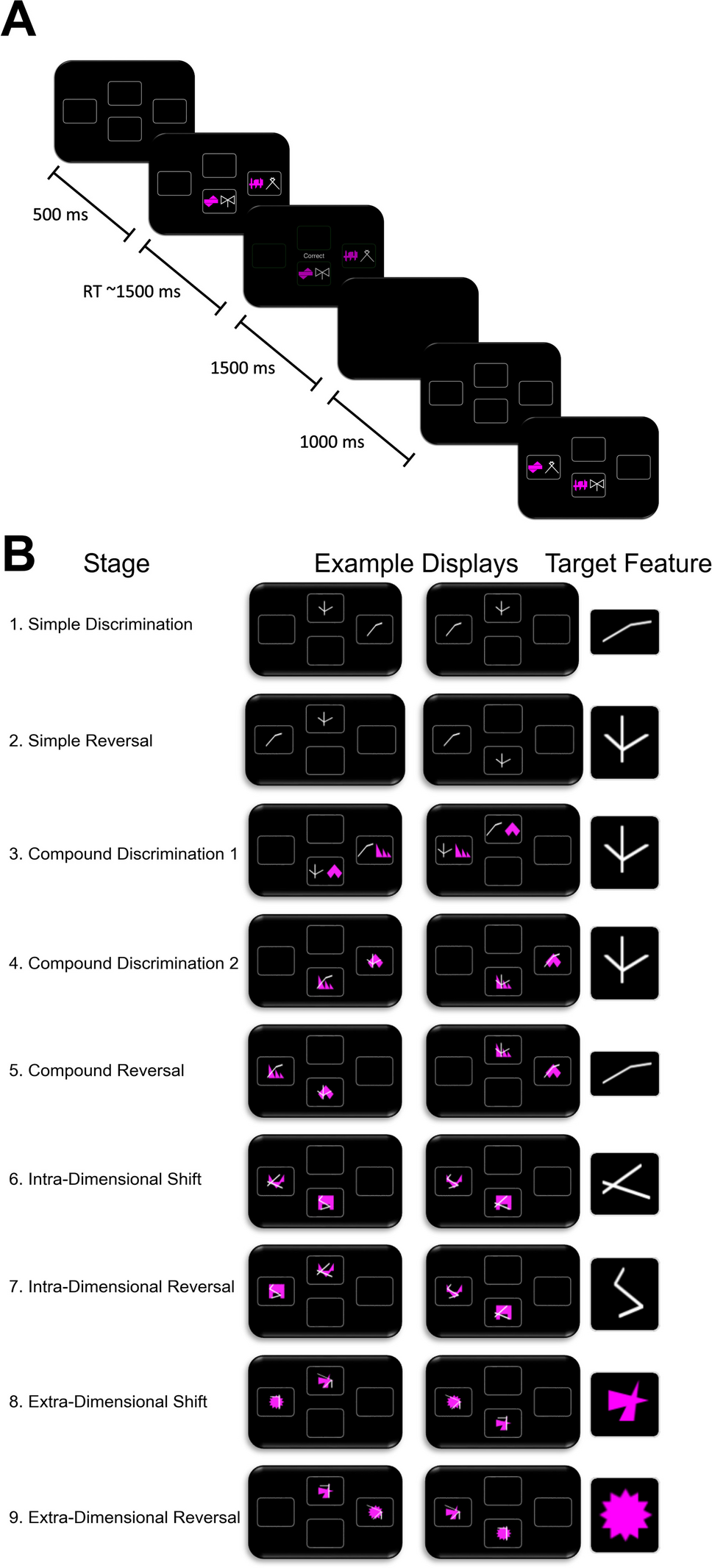 shows a representative trial from this stage (compound discrimination). For a shape-appendage version, CD1 could show appendages as a separate halo beside the body and CD2 attach them to the organism.
Alternative Parametric Stimulus Families
1. Procedural microorganisms (rating: 5/5)
Formalised version of the Brain Explorer approach. Objects defined by four independent dimensions: outer contour (radial frequency, modulation amplitude, aspect ratio), appendages (length, curvature, orientation), surface texture (spots, stripes, Voronoi cells), and colour (hue, chroma, brightness). Contour generated from radial Fourier components: r(θ) = R[1 + Σ a_k cos(f_k θ + φ_k)]. Easy to generate thousands of unique exemplars; dimensions independently switchable; directly renderable as SVG/PNG/Psychtoolbox textures.
2. RUBubbles (rating: 4/5)
Coloured spheres arranged in 3-D space with independently controllable number, size, colour, position, and configuration. Existing MATLAB implementation; large multidimensional space; good for category-learning studies [3]. Limitation: sphere number is partly a numerosity dimension, and configuration may be processed holistically.
3. Fribbles (rating: 3.5/5)
Multipart novel objects with interchangeable components at defined positions [4]. Dimensions correspond to identifiable object parts (body, upper/lower appendage, tail). Limitation: parts not equally discriminable; encourages local part-comparison rather than abstract dimension selection.
4. Geon/superquadric assemblies (rating: 4/5)
Objects assembled from parametric solids (spheres, cylinders, cones, rounded cubes). Part shape, number, arrangement, size, texture, and colour as dimensions. Easy to generate in Blender/Unity/MATLAB; continuous morphs possible; simpler and more experimentally transparent than Quaddles.
5. Superformula/Fourier supershapes (rating: 5/5 as shape engine)
Gielis superformula and related functions generate organic, polygonal, multi-lobed contours from compact parameters [5]. Best used as the shape engine inside a microorganism generator rather than as a complete stimulus family.
6. Motion-augmented objects (rating: 4.5/5 as optional dimension)
Clockwise vs anticlockwise rotation, upward vs downward internal flow, expansion vs contraction, etc. Cross-species study in macaques and humans validated motion as a dimension for IED [6]. Motion may be preferable to quantity/numerosity dimensions (e.g., hair count, dot number) which involve different computations.
7. Greebles and Ziggerins (rating: 2.5/5)
Established novel-object stimuli for expertise and face-like configural processing [7]. Not ideal for IED: features not cleanly factorial, objects are strongly configural, discriminability unequal across parts.
8. AI-generated imaginary objects (rating: 2/5)
IMAGINE dataset of 400 GAN-generated novel objects with quantified image properties [8]. Useful as generalisation/novelty probes, but generative variables don’t correspond reliably to clean psychological dimensions for the primary IED task.
Concrete Microorganism Generator
Shape layer
Radial Fourier components generate the boundary: base radius, aspect ratio, radial frequencies (2-3), amplitudes, phases, asymmetry, smoothing. After generation, normalise enclosed area, max width/height, centroid, and mean radius to prevent size/eccentricity confounds.
Appendage layer
Place appendages at equal arc-length intervals (not equal-angle) to avoid clustering around elongated portions. Fix count and total appendage ink; vary shape or curvature (straight vs curved, pointed vs rounded tips, single vs bifurcated ends). This avoids turning the task into sparse-vs-dense classification.
Texture layer
Poisson-disc spots, sinusoidal stripes, concentric waves, Voronoi boundaries, checker patterns, band-limited noise — rendered inside a clipping mask defined by the body contour. Match mean luminance, RMS contrast, total covered area, and approximate edge density across texture types.
Colour layer
Device-independent perceptually organised representation (hue, chroma, luminance). Hold luminance approximately constant; use well-separated hues; behaviourally calibrate colour discriminability on the target display rather than assuming from nominal RGB distances.
Dataset Specification & Sampling
Every stimulus generated from a JSON manifest (containing stimulus_id, seed, task_set, and all generative parameters). Generator output includes SVG (editable/inspectable), PNG (pre-rendered for Psychtoolbox), masks, thumbnails, and quality-control metadata.
For 12 shape × 8 appendage × 8 texture × 8 colour exemplars, the latent space is 6,144 combinations. Strategy: generate large candidate pool, reject stimuli failing image-metric constraints, divide into stage-specific sets, reserve completely held-out seeds for IDS/EDS. Crucially, do not reuse the same shapes with different textures — independent exemplars per stage ensure transfer reflects attention to dimension rather than object memorisation.
Perceptual Calibration
-
Single-dimension discrimination — test each dimension in isolation (same/different, odd-one-out, 2AFC, matching-to-sample). Select levels producing ~85–90% correct, approximately matched across dimensions, to avoid feature-salience confounds.
-
Dimensional separability (Garner paradigm) — compare performance when irrelevant dimension is constant (control) vs varying (filtering). Some Garner interference is acceptable but should be measured rather than left unknown [11].
-
Counterbalancing — across subjects: shape-first vs texture-first, which exemplar is initially rewarded, left-right position, and stage-specific stimulus sets.
Practical Recommendation
Use two complementary stimulus systems:
- Primary IED battery: 2-D procedural microorganisms (shape, texture, appendage morphology, colour, optional motion) — for the close CANTAB analogue requiring thousands of trial-unique exemplars and exact factorisation of dimensions.
- Generalisation battery: Quaddles or RUBubbles — to test whether measured shift costs generalise from simple feature-factorised glyphs to richer 3-D objects.
This separation distinguishes a genuine attentional-set deficit from difficulty parsing any one particular kind of complex object.
References
- Cambridge Cognition — Intra-Extra Dimensional Set Shift (IED) — https://cambridgecognition.com/intra-extra-dimensional-set-shift-ied/
- Radial-frequency contour stimuli — https://www.sciencedirect.com/science/article/pii/S0042698918302219
- RUBubbles stimulus set — https://pmc.ncbi.nlm.nih.gov/articles/PMC9374653/
- Fribbles as multipart novel-object stimuli — https://pmc.ncbi.nlm.nih.gov/articles/PMC3921574/
- Superformula-based parametric shape generation — https://link.springer.com/article/10.1007/s00158-018-2034-z
- Cross-species set shifting using shape, colour, and motion — https://pmc.ncbi.nlm.nih.gov/articles/PMC9807625/
- Greebles and Ziggerins — https://pmc.ncbi.nlm.nih.gov/articles/PMC2919853/
- IMAGINE dataset — https://www.nature.com/articles/s41597-023-02483-7
- Nine-stage ID/ED procedure — https://pmc.ncbi.nlm.nih.gov/articles/PMC5904264/
- Quaddles stimulus set — https://link.springer.com/article/10.3758/s13428-018-1097-5
- Garner interference — https://pubmed.ncbi.nlm.nih.gov/27732017/
- Classic comparative ID/ED work — https://journals.sagepub.com/doi/10.1080/14640748808402328
- Quaddle 2.0 — https://xwen1765.github.io/posts/Quaddle/
Related Pages
intradimensional-extradimensional-shift | cantab | nonverbal-cognitive-tasks | preclinical-drug-screening