Intradimensional/Extradimensional Shift (ID/ED)
The non-verbal Intradimensional/Extradimensional (ID/ED) Shift task measures cognitive flexibility and frontostriatal/frontoparietal brain function, testing how well a subject adapts when the rules of the world change.
Mechanism
The subject is presented with visual shapes on a screen and learns by trial-and-error to select the correct shape to receive a reward. Once they master this rule, the criteria changes (e.g., the reward is no longer based on the shape, but on the colour). The task tests:
- Intradimensional shift — same dimension, different exemplars (easier)
- Extradimensional shift — switch to a different dimension entirely (harder; the core measure of cognitive flexibility)
Depression Marker
Depressed children and animals display severe perseveration — they continuously select the old, incorrect choice repeatedly. Their brains struggle to flexibly update behaviour when environmental contingencies shift, a core cognitive deficit in major depressive disorder. [18]
This perseveration indicates frontostriatal circuit dysfunction, linking depression to impaired top-down cognitive control.
MEG-Compatible Version (Mogadam et al., 2018)
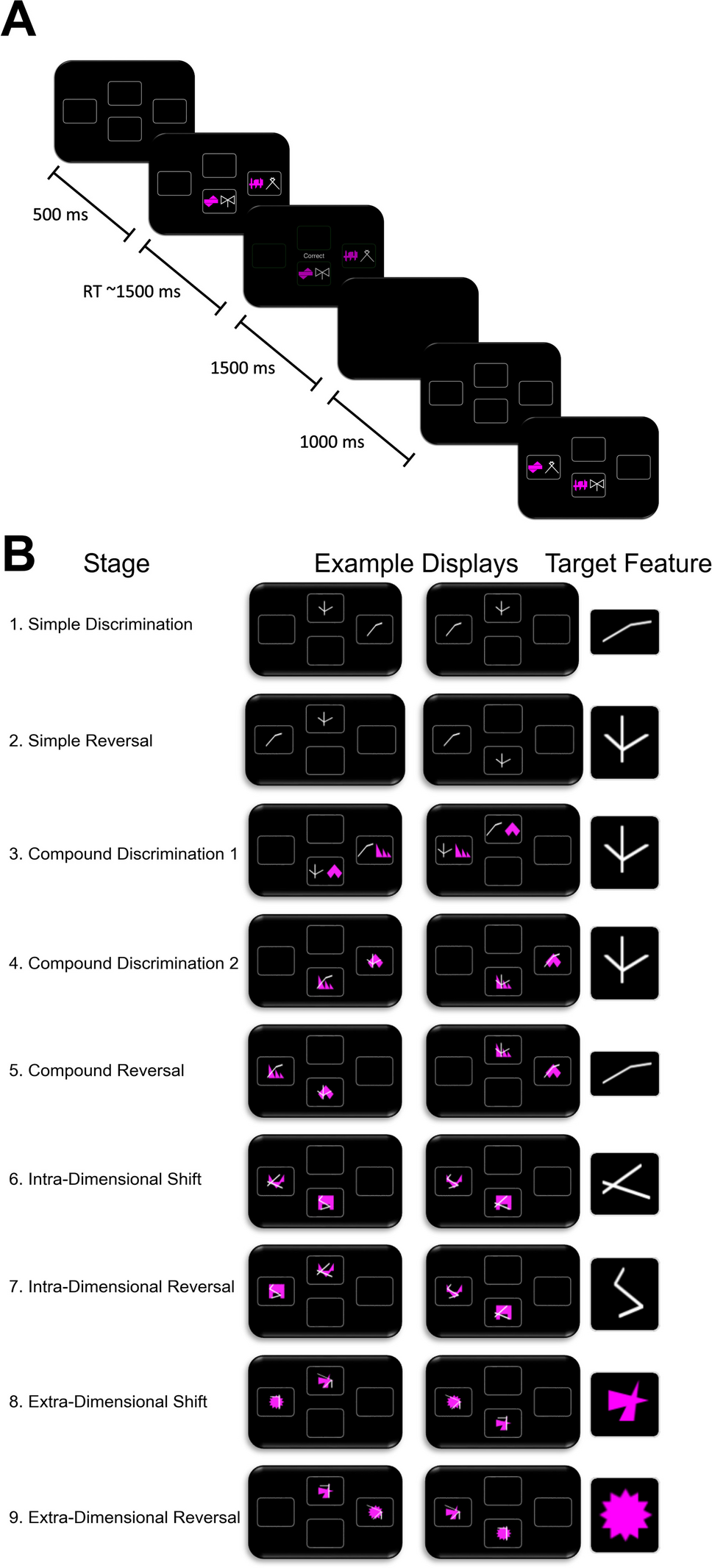
A modified MEG-compatible version of the IED set-shifting task was developed for investigating the temporal dynamics of mental flexibility in children (Mogadam, Keller, Taylor, Lerch, Anagnostou & Pang, Brain and Cognition, 2018).
Task Figure:
Easy Shift (intradimensional) and Hard Shift (extradimensional) trials from the MEG-compatible IED task. Adapted from Mogadam et al. (2018).
Key Design Features
- Stimuli: Visual shapes presented via prism glasses inside the MEG scanner
- Response: Non-magnetic response device (minimises head movement for MEG source localisation)
- Rapid event-related design for averaging of neural MEG trials
- No auditory confounds (purely visual)
Neural Findings in Typically Developing Children (8-15 years)
- Children recruit the same frontoparietal network as adults
- But children preferentially rely on posterior parietal cortices (vs. more frontal in adults)
- Additional recruitment of temporal pole and premotor areas as compensatory support
- Peak neural activity: 75-350 ms post-stimulus
- Developmental effect: Activation latency decreases significantly with increasing age
Relevance to Depression Research
The MEG-compatible version enables temporal characterization of the neural deficits underlying perseveration in mood disorders — specifically whether depression-related set-shifting deficits manifest in the early 75-350 ms processing window, and whether they arise from parietal or frontal circuit dysfunction.
CANTAB Implementation
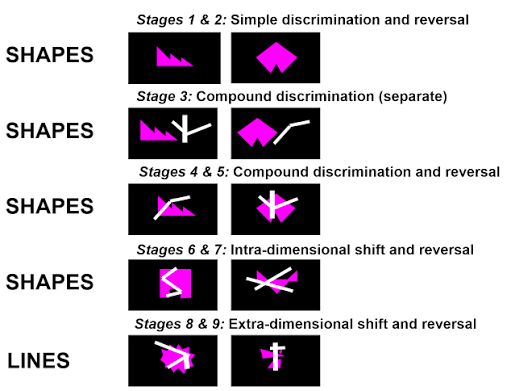
Top: single trial from Stage 3 (compound discrimination) showing pink shapes and white lines (Talwar et al., 2024). Bottom: complete nine-stage progression of the CANTAB IED task, from simple discrimination (Stage 1) through intra-dimensional shift (Stages 6–7) to the critical extra-dimensional shift (Stages 8–9). The relevant dimension switches from shapes (purple) to lines at the extra-dimensional shift.
Within the cantab battery, the ID/ED task is part of the standard executive function assessment. The task uses two artificial dimensions — pink shapes and white lines — which progress from simple (single-dimension) to compound (overlaid) stimuli across nine stages (SD → SDR → CD1 → CD2 → CDR → IDS → IDR → EDS → EDR). A trial at Stage 3 (compound discrimination 1) is shown above, where both dimensions are present but the pink shape remains the relevant dimension. See the one-touch-stockings-cambridge task for a complementary measure of spatial planning.
Stimulus Design for IED Tasks
A critical methodological consideration for IED experiments is the stimulus space itself — objects must have at least two independently variable perceptual dimensions (e.g., shape vs texture, colour vs appendage morphology), and the generator must produce many novel exemplars within each dimension rather than merely recombining a handful of familiar objects.
The recommended approach is a procedural microorganism library with four independent layers (shape, surface texture, appendages, colour), using only two dimensions within any one CANTAB-style IED sequence. This enables clean factorisation, thousands of trial-unique exemplars, and deterministic touchscreen rendering without viewpoint/lighting confounds. A concrete nine-stage implementation maps the standard CANTAB progression (separate → compound → shift) onto these microorganism dimensions.
A detailed analysis of eight candidate stimulus families — including ratings, implementation guidance, generator architecture, perceptual calibration protocol, and dataset specification — is available at parametric-ied-stimulus-design.
Rodent Automation (ConductMaze)
The ID/ED task has been adapted for automated rodent testing using the ConductMaze system (ConductScience), supporting both digging-bowl and touchscreen formats. The software manages stimulus presentation order, randomises compound configurations, tracks digging choices or screen touches, scores correct/incorrect responses, and advances the animal through stages based on configurable criterion rules (e.g., 6 consecutive correct).
Seven-Stage Protocol
The rodent protocol uses a simplified 7-stage progression (vs. the 9-stage CANTAB human version):
| Stage | Abbreviation | Description |
|---|---|---|
| 1 | SD | Simple discrimination — one dimension relevant |
| 2 | CD | Compound discrimination — both dimensions present, original relevant |
| 3 | CDR | Compound discrimination reversal — reward switches within same dimension |
| 4 | IDS | Intradimensional shift — new exemplars, same relevant dimension |
| 5 | IDR | Intradimensional reversal — reward switches within new exemplars |
| 6 | EDS | Extradimensional shift — previously irrelevant dimension becomes relevant |
| 7 | EDR | Extradimensional reversal — reward switches within new dimension |
Key Parameters
| Parameter | Default | Description |
|---|---|---|
| Stimulus Dimensions | Odor/Texture | Two perceptual dimensions for compound stimuli |
| Criterion | 6 | Consecutive correct trials to advance |
| Max Trials per Stage | 50 | Maximum before failing a stage |
| ITI Duration | 15 s | Inter-trial interval |
| Choice Timeout | 300 s | Maximum time for bowl selection |
| Reward | Cheerio piece | Food reward buried in correct medium |
Primary Metrics
- Trials to Criterion (per stage) — the main outcome measure
- ED-ID Difference — EDS trials minus IDS trials; indexes set-shifting cost
- Errors to Criterion — total incorrect trials before criterion
- Perseverative Errors — errors to previously rewarded stimulus during reversals
- Choice Latency — mean time from presentation to committed response
Neural and Pharmacological Sensitivity
The EDS stage is selectively impaired by lesions of the medial prefrontal cortex in rodents (homologous to dorsolateral PFC in primates). The task is sensitive to:
- Serotonergic manipulations (5-HT depletion impairs reversal but not EDS)
- Noradrenergic manipulations (NE depletion impairs EDS specifically)
- Dopaminergic modulation of reversal learning (via orbitofrontal/striatal circuits)
Applications
- Prefrontal cortex lesion and inactivation studies
- Schizophrenia modelling (cognitive inflexibility as translational endpoint)
- ADHD research (attentional set formation under catecholamine manipulation)
- Ageing and dementia (executive decline in transgenic AD models)
- Psychopharmacology (serotonergic vs noradrenergic modulation of reversal vs set-shifting)
Technical Specification: MonkeyCantab ID/ED Task
Source: MonkeyCantab User’s Guide (Cambridge University Technical Services Ltd / Lafayette Instrument), pp. 65-68. See raw paper.
Dimensions and Stimuli
In human testing (e.g. Wisconsin Card Sorting Test, Grant & Berg 1948), typical dimensions are colour, shape, and number. In primate testing, two standard dimensions are “blue shapes” (background) and “white squiggly lines” (superimposed foreground), following Dias, Robbins & Roberts (1997, J Neurosci 17: 9285-9297). A large number of exemplars per dimension encourages extraction of general features (learning “red is correct” rather than “red triangle is correct”).
Irrelevant Dimension Control
When a dimension is present but should be ignored, the experimenter must ensure p(correct) does not depend on its value. Two strategies:
- Hold constant — e.g. always present stimuli in a single location, always use purple background
- Randomize — e.g. randomize left/right position each trial; the subject may attempt to learn on this dimension but cannot succeed
Required Stimulus Library
The task requires objects in each of these categories (where “anything” means any value other than undefined, held constant or randomized):
| Category | Dimension A | Dimension B |
|---|---|---|
| 1 | A=1 | B=undefined |
| 2 | A=2 | B=undefined |
| 3 | A=1 | B=anything |
| 4 | A=2 | B=anything |
| 5 | A=3 | B=anything |
| 6 | A=4 | B=anything |
| 7 | A=anything | B=1 |
| 8 | A=anything | B=2 |
MonkeyCantab Test Sequence
| Stage | Stimulus Pairs | Notes |
|---|---|---|
| Simple discrimination (SD) | A1(+), A2(-) | Only dimension A present |
| Reversal (SDR) | A2(+), A1(-) | Reverse within A |
| Compound discrimination (CD) | A1/B1(+), A2/B2(-); A1/B2(+), A2/B1(-) | Both dimensions present, B ignored |
| Reversal (CDR) | A2/B1(+), A1/B2(-); A2/B2(+), A1/B1(-) | Reverse within A, B still ignored |
| Intradimensional shift (IDS) | A3/B3(+), A4/B4(-); A3/B4(+), A4/B3(-) | New A exemplars, B ignored |
| Reversal (IDR, optional) | A4/B3(+), A3/B4(-); A4/B4(+), A3/B3(-) | Reverse within new A exemplars |
| Extradimensional shift (EDS) | B5/A5(+), B6/A6(-); B5/A6(+), B6/A5(-) | Switch to dimension B, A ignored |
| Reversal (EDR, optional) | B6/A5(+), B5/A6(-); B6/A6(+), B5/A5(-) | Reverse within B |
Criterion and Trial Control
- Criterion: 6 consecutive correct responses (configurable)
- Position: left/right randomised for each trial
- Pair order: presentation of alternative pairs (e.g. A1/B1-A2/B2 vs A1/B2-A2/B1) randomised in pairs of trials
Comparison with Rat Digging-Bowl Task (Birrell & Brown, 2000)
Rats dig in bowls with dimensions of odour, filling medium, and surface texture. Key difference: rats use a total change design (all stimuli change at ID/ED shifts), while MonkeyCantab introduces new exemplars only in the relevant dimension. The total change design is required for accurate interpretation of the difference between reversal learning and ED shifts (Birrell & Brown, 2000, J Neurosci 20: 4320-4324).
Stimulus Configuration Modes
- Predefined Stimuli Style — experimenter manually creates compound stimuli from arbitrary dimensions (colour/shape, shape/line, etc.). Requires 14 objects (A1, A2, A1/B1, A1/B2, A2/B1, A2/B2, A3/B3, A3/B4, A4/B3, A4/B4, A5/B5, A5/B6, A6/B5, A6/B6).
- Superimposed Stimuli Style — compound stimuli generated by layering simple stimuli (e.g. shape + line), saving the effort of creating each compound manually.
Related Pages
parametric-ied-stimulus-design | nonverbal-cognitive-tasks | cantab | delayed-match-to-sample | cognitive-judgement-bias | one-touch-stockings-cambridge | preclinical-drug-screening