Skip to content Skip to navigation

Search:
Photovoltaic Retinal Prosthesis for Restoration of Sight in Retinal Degeneration
Retinal degenerative diseases lead to blindness due to loss of the “image capturing” photoreceptors, while neurons in the “image-processing” inner retinal layers are relatively well preserved. Information can be reintroduced into the visual system using electrical stimulation of the second-order retinal neurons, the bipolar cells, which then transfer their responses to the rest of the retinal neural network. This approach enables preservation of many features of the retinal signal processing, and thereby allows restoration of sight. We developed a photovoltaic subretinal prosthesis, which converts incident light into pulsed electric current, stimulating the nearby inner retinal neurons. Results of the clinical trial with our implants (PRIMA, Pixium Vision) having 100μm pixels, as well as preclinical measurements in rodents with 75 and 55 μm pixels, confirm that spatial resolution of prosthetic vision can reach the sampling density limit.
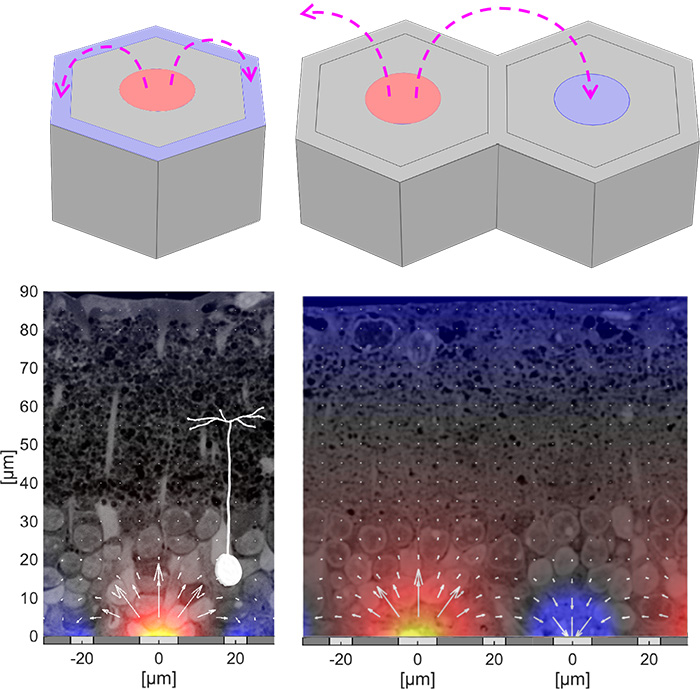
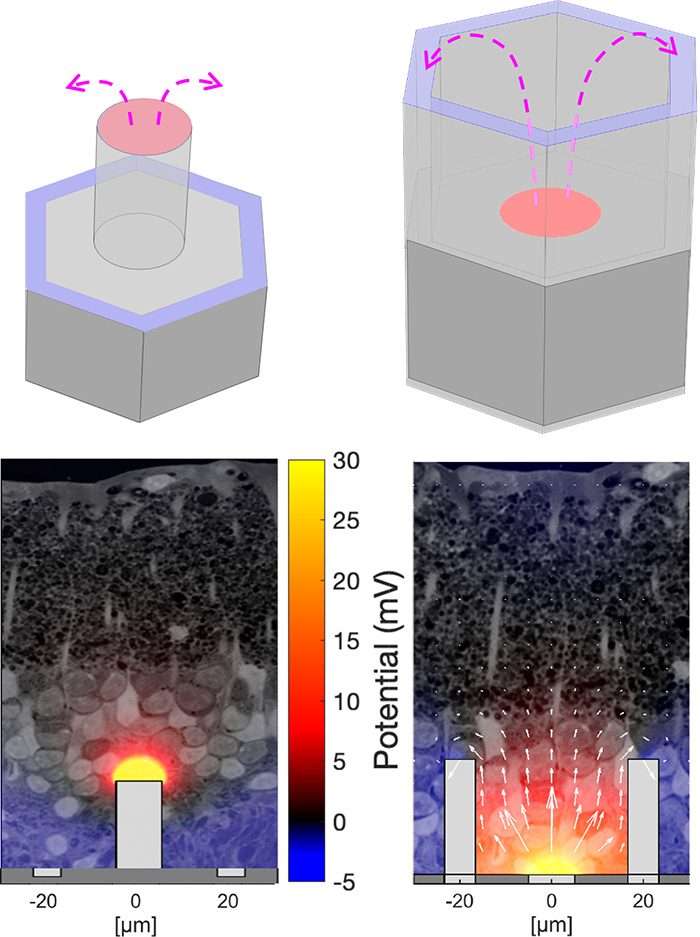
For a broad acceptance of this technology by patients who lost central vision due to age-related macular degeneration, visual acuity should exceed 20/100, which requires pixels smaller than 25um. Radial expansion of electric field in front of the flat arrays precludes scaling the pixels to such small dimensions. We are working on 3-dimensional electro-neural interfaces which should enable such a high resolution, and may even reach single-cell selectivity.
1-min animation of the concept
3-min animation and summary from the Department of Ophthalmology
Recent seminar about the project (1 hour, January 20, 2026)
System Design

PRIMA system design
The data stream from a video camera is processed by a pocket PC, and the resulting images are displayed on the augmented-reality glasses, shown on the right. Images are projected from a DMD microdisplay onto the subretinal implant (lower image on the right) using pulsed (1-10 ms) near-infrared (880 nm) light. These light pulses are photovoltaicly converted into bi-phasic pulses of electric current flowing through the retina between the active and return electrode in each pixel, which stimulate the nearby inner retinal neurons, thereby introducing visual information into the retinal neural network. Optical delivery of the information and power allows for simultaneous activation of thousands of pixels in the implant, and retains the natural link between the eye movements and visual perception.
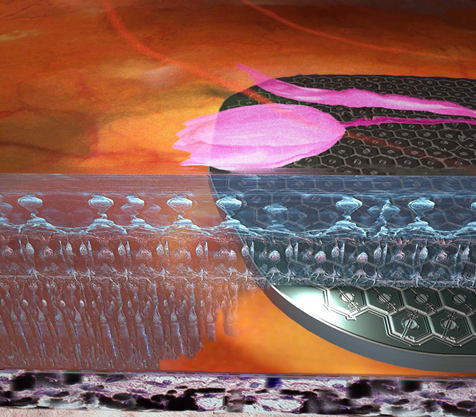
subretinal photovoltaic array
In preclinical studies, we found that prosthetic vision with subretinal implants preserves many features of the natural visual processing, including flicker fusion at high frequencies (>20 Hz), adaptation to static images, antagonistic center-surround organization and non-linear summation of subunits in the receptive fields, providing high spatial resolution. Results of the clinical trial with our implants (PRIMA, Pixium Vision) having 100μm pixels confirm that spatial resolution of prosthetic vision can reach the pixel pitch (20/420 visual acuity with 100μm pixels). Patients also demonstrated simultaneous perception of the peripheral natural and the central prosthetic vision.
We continue to study the mechanisms of neural stimulation and characteristics of prosthetic vision ex-vivio and in-vivo, and optimize the system to enable high resolution prosthetic vision. These studies include modeling of the electric field in tissue, neural response to electric field, electrode-electrolyte interface and circuit dynamics, fabrication of the implants, and electrophysiological assessement of the retinal, cortical and behavioral responses to visual stimuli. We also participate in the design and data analys of the clinical trials of our PRIMA system manufactured by Pixium Vision.
To support our research, please visit give.stanford.edu, then under “Direct your gift,” choose “Other Designation” and enter “Palanker Fund: GHFCH” in the field. Thank you for your support!