TDK
Scope. Tokyo-based electronics multinational (TSE:6762) that in October 2026 demonstrated a meta-optic mirror direct retinal projection (DRP) display for smart glasses — a flat, 150-nm-thick in-lens mirror that replaces both waveguides and the conventional curved-mirror DRP optics. The work sits in the display-optics space of augmented-vision and the product landscape of smart-glasses, and pairs TDK’s laser light-engine components with QD Laser’s retinal-projection technology.
Overview
TDK Corporation (TSE:6762) is a global electronics technology company based in Tokyo with a legacy spanning “over 90 years” of components — from the pioneering ferrite cores to cassette tapes that defined an era, and on to passive components, sensors, power supplies, lithium-ion and solid-state batteries, magnetic heads and AI/enterprise software. Products are marketed under the brands TDK, InvenSense, Micronas, Tronics, TDK-Lambda, TDK SensEI and ATL. In fiscal 2026 the company reported total sales of USD 16.6 billion and about 107,000 employees worldwide; it names the AI ecosystem — including smart glasses as a priority application — as a key strategic area. 1
Meta-optic mirror DRP (2026)
On 2 October 2026 TDK announced what it describes as the world’s first demonstration of a direct retinal projection display for smart glasses using a meta-optic mirror: a flat mirror of nanoscale reflectors, 150 nm thick, embedded directly inside an eyeglass lens, with visible-light transmittance of ~80% — transparency equivalent to ordinary eyeglass lenses. 1 2
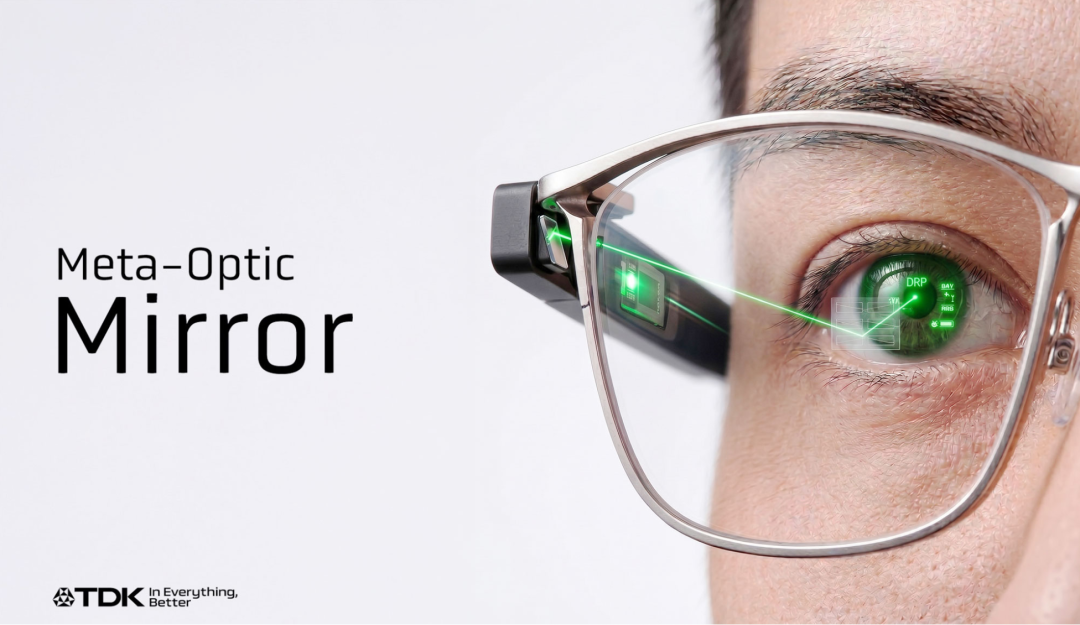
TDK’s meta-optic mirror DRP prototype: laser light from the temple-side laser engine is reflected by the in-lens mirror directly into the eye — ahead of the CEATEC 2026 demonstration. (Image: TDK via XR Vision, October 2026; reproduced for research reference.)
Mechanism: conventional DRP places a bulky curved mirror in front of the eye to project the image onto the retina; TDK instead arranges nanoscale reflectors on a planar substrate so that the reflection angle varies with position across the mirror (a “negative reflection angle” design), redirecting laser light incident from various angles at exactly the angle DRP requires — a drop-in replacement for the curved mirror. Because the image is written directly on the retina through a planar mirror, the projected content is not visible to observers facing the wearer (no image leakage), and the rainbow artifacts of waveguide displays are absent. The article introducing the technology frames it as smart-glasses display’s “third technical route” — neither waveguide nor curved mirror. 1 2
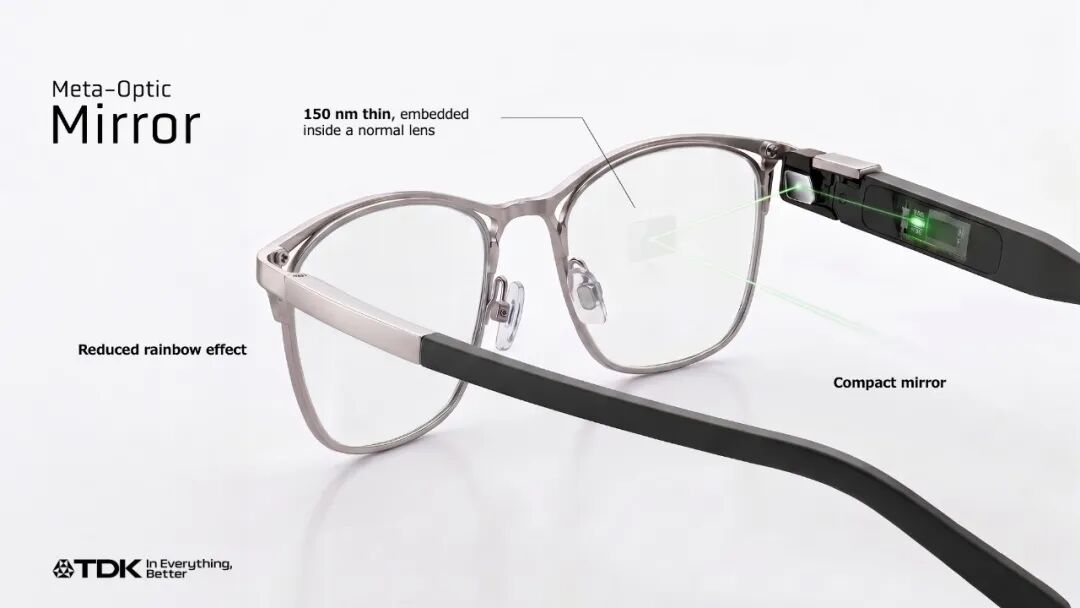
The annotated prototype: the 150-nm mirror is embedded inside a normal lens; reduced rainbow effect; compact mirror. (Image: TDK via XR Vision, October 2026; reproduced for research reference.)
Supporting components come from TDK’s laser portfolio: an ultra-compact full-colour laser module (FCLM) — among the smallest of its kind worldwide — and a visible-light full-colour laser control device capable of 4K resolution. Because the mirror can be manufactured with semiconductor-style wafer processes, TDK positions it as a cost-competitive route to volume production versus complex, costly waveguide displays. The current demonstration is monochrome; TDK aims to demonstrate full colour and reach mass production “within the next few years”. Prototypes will be exhibited at CEATEC 2026 (from 13 October 2026) and at electronica, Munich (10–13 November 2026). 1 2
QD Laser partnership
Alongside the demonstration, TDK has entered a business cooperation agreement with QD Laser, Inc. (TSE:6613) — the Japanese laser company whose RETISSA / VISIRIUM retinal-projection eyewear is the commercial survivor of the earlier DRP wave (see augmented-vision). The partnership combines QD Laser’s proprietary retinal projection technology and patent portfolio with TDK’s FCLM, visible-light full-colour laser controllers and meta-optic mirrors to accelerate development of next-generation RGB light source modules and optical engines for smart glasses. 1 2
Beyond smart glasses
TDK says meta-optics has applications beyond wearable displays — notably photoelectric conversion devices for AI data centres, converting electrical signals into optical signals for high-speed, energy-efficient communication, which could make meta-optics a foundational technology of next-generation digital infrastructure. TDK is conducting initial evaluations of the glasses and preparing a full-colour demonstration. 2
Timeline
- 2026-10-02 — TDK press release and technology feature published; claimed world-first DRP demonstration using the meta-optic mirror. 1 2
- 2026-10-13 — prototype to be exhibited at CEATEC 2026. 1
- 2026-11-10–13 — prototype to be exhibited at electronica (Munich). 1
See Also
- augmented-vision — display/projection technology page (retinal projection section; product map)
- smart-glasses — category overview and product landscape
- micro-led — the display supply chain the waveguide route draws on (TDK’s route is the laser alternative)
References
- XR Vision (2026-10-03). TDK launches a retinal-projection display with no waveguide; Rokid partners with Krys Opticiens (WeChat; English translation). 2
- TDK Corporation (2026-10-02). TDK demonstrates the world’s first direct retinal projection display for smart glasses using a meta-optic mirror (press release). 1
- TDK Corporation (2026-10-02). Meta-Optic Mirror: Bringing Smart Glasses into Everyday Life (featured story; link).