Smart Glasses
Overview
Smart glasses are eyewear that adds computing and sensors and/or a heads-up display (HUD) for information. The category spans a spectrum: audio-only frames → camera-based frames → text HUD glasses → larger AR/MR headsets (here “smart glasses” is used for the wearable form factor, not “smart glass” switchable window technology). 1
There is no single inventor. The category grew from 1930s science-fiction roots, through 1960s head-mounted display research, 1990s augmented reality (AR) definitions and tracking work, and 2000s–2010s attempts to shrink systems into consumer eyewear. 1
History
1935 — The conceptual root in fiction
Stanley G. Weinbaum’s short story Pygmalion’s Spectacles describes eyewear that delivers an immersive experience — an early sign that the “information and media in front of your eyes” idea was recurring. Not engineering, but a conceptual seed. 1
1968 — Sutherland’s “Sword of Damocles” (the first technical ancestor)
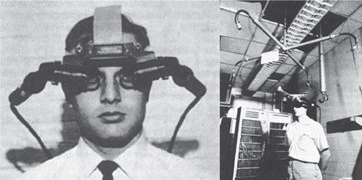
The most-cited milestone: Ivan E. Sutherland’s head-mounted display work at Harvard/Utah, nicknamed the “Sword of Damocles” because the bulky rig had to be suspended from the ceiling. His paper, “A head-mounted three dimensional display”, describes a system that renders computer graphics in view — the ancestor of both VR and AR displays. The original device used two small CRT displays and half-silvered optics, with head tracking so the imagery updated with the wearer’s head movements.
1990s — AR becomes a defined research field
Researchers converged on what AR should mean and what the hard problems were (tracking, alignment, latency, human factors). Ronald Azuma’s survey is still one of the most-cited summaries, framing AR as: combining real and virtual, interactive in real time, and registered in 3D. 1
2000s — Wearable computing as a product category
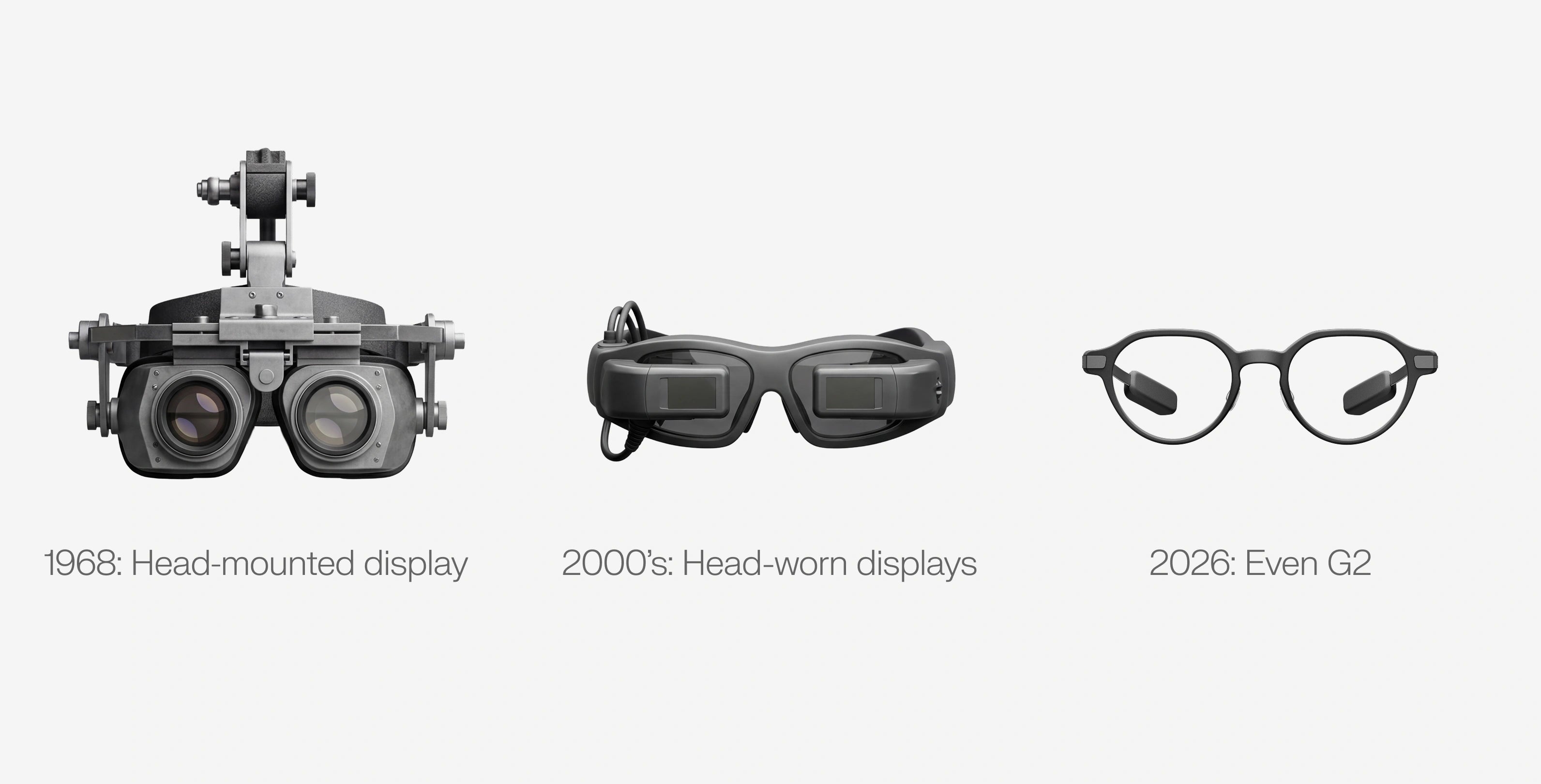
Attempts to push head-worn displays out of labs: maintenance, remote support, training, navigation. Many looked promising in controlled settings but fought size, heat, battery limits, and input friction. 1
Early 2010s — The first mass-market wave (Google Glass era)
Consumer awareness peaked: connected eyewear became a public conversation — and provoked backlash. Late 2010s: enterprise use continued while consumers cooled; the category narrowed to places with clear ROI. 2020s: lighter designs, clearer categories (AI assistant frames, text HUD glasses, virtual screens). 2026: major platform roadmaps keep pressure on miniaturization. 1
AR and 3D Tracking
AR’s defining technical challenge has always been registration — keeping virtual content aligned with the physical world. Azuma’s three criteria define the field: combine real + virtual, interactive in real time, registered in 3D. The persistent hard problems are tracking, alignment, latency, and human factors. 1
Modern research glasses solve this with on-device machine perception: visual-inertial odometry (VIO) tracks the device in six degrees of freedom (6DOF) within a spatial frame of reference; stereo camera overlap enables dense depth (e.g., Meta’s Aria Gen 2 uses 80° stereo overlap to drive stereo foundation models such as NVIDIA FoundationStereo for scene reconstruction); camera-based eye tracking yields gaze per eye, vergence point, blinks and pupil metrics; hand tracking yields articulated 3D hand poses. See project-aria. 2
Why Early Waves Failed
The Google Glass lesson: the failure wasn’t purely technical. Recurring issues were unclear everyday value versus the phone, high price perception and limited distribution, privacy stigma from face-worn cameras, and a thin ecosystem of “must-have” apps. 1
Deeper category-wide barriers: comfort and fit (weight, balance, pressure points), battery and heat in small frames, input friction (awkward voice/touch in public), cost-vs-payoff, and unsettled social norms about what is acceptable on someone’s face. 1
| Barrier | Early consumer wave | Now |
|---|---|---|
| Privacy trust | Camera uncertainty, stigma | Camera-free options + clearer signals |
| Comfort | Bulkier frames, hot spots | Lighter builds, better balance |
| Input | Clunky touch + voice-only | More options (rings, better voice UX) |
| Value | ”Nice demo”, weak daily habit | AI + glanceable utilities feel useful fast |
| Apps | Thin ecosystem | Uneven but clearer jobs-to-be-done |
What Changed in the 2020s
- AI fits the form factor: short interactions (summarize, translate, define, quick Q&A) map naturally to a small display checked for a few seconds. 1
- Smaller parts + better power/heat management make “short, frequent use” realistic.
- Industrial design caught up: looks like normal eyewear, prescription support, all-day wearability.
- Privacy-by-design options: e.g., Even G2 is display-first and camera-free (no cameras, no speakers), floating monochrome display, discreet control via a ring, titanium temples and IP65 rating.
Current State & Trajectory
Enterprise and niche use persisted because ROI (time saved, fewer errors, faster support) was measurable; consumer interest is rebuilding as constraints ease and AI delivers instant usefulness. “Mainstream” means comfortable, socially acceptable and helpful enough for daily wear by non-enthusiasts. A plausible next step: lighter AR displays with more realistic depth cues without heavy optics or high power draw, plus neural input. 1
Meta’s Project Aria / Aria Gen 2
Aria is a key 2020s research platform on this trajectory: Meta’s egocentric machine-perception program with glasses used by 200+ academic and corporate partners, paired with open datasets, models and tooling. Aria Gen 1 (2020) launched the program; Aria Gen 2 (2025) adds on-device compute on a custom coprocessor, 6DOF VIO tracking, eye tracking, 3D hand tracking, ASR, a contact microphone, PPG heart-rate sensing and sub-millisecond multi-device time alignment — human-in-the-loop sensing aimed at contextual AI and robotics. Available to researchers via the rolling Aria Research Kit application. See project-aria for the full spec sheet. 2 3
See Also
- project-aria — Meta’s egocentric machine-perception research glasses (Gen 1/Gen 2)
- augmented-vision — display/projection technologies behind HUD/AR eyewear (waveguides, birdbath, retinal projection, light engines; Even HAO, Meta Ray-Ban Display/Orion, Apple patents)
- digital-device-associated-aace — vision/eye-health consequences of sustained near screen use in the digital-device era
- digital-therapeutics-for-vergence — VR-based binocular therapy; wearable-display technology applied to vision rehabilitation
References
- Even Realities (2026). Who Invented Smart Glasses? The Complete History & Why They Failed. 1
- Meta AI (2025-06-04). Inside Aria Gen 2: Explore the cutting-edge tech behind the device. 2
- Project Aria (Meta). Aria Gen 2, from Meta homepage. 3